

The Work/Life Conundrum
The Need for a System Overhaul

Work? Play? Or something in between?
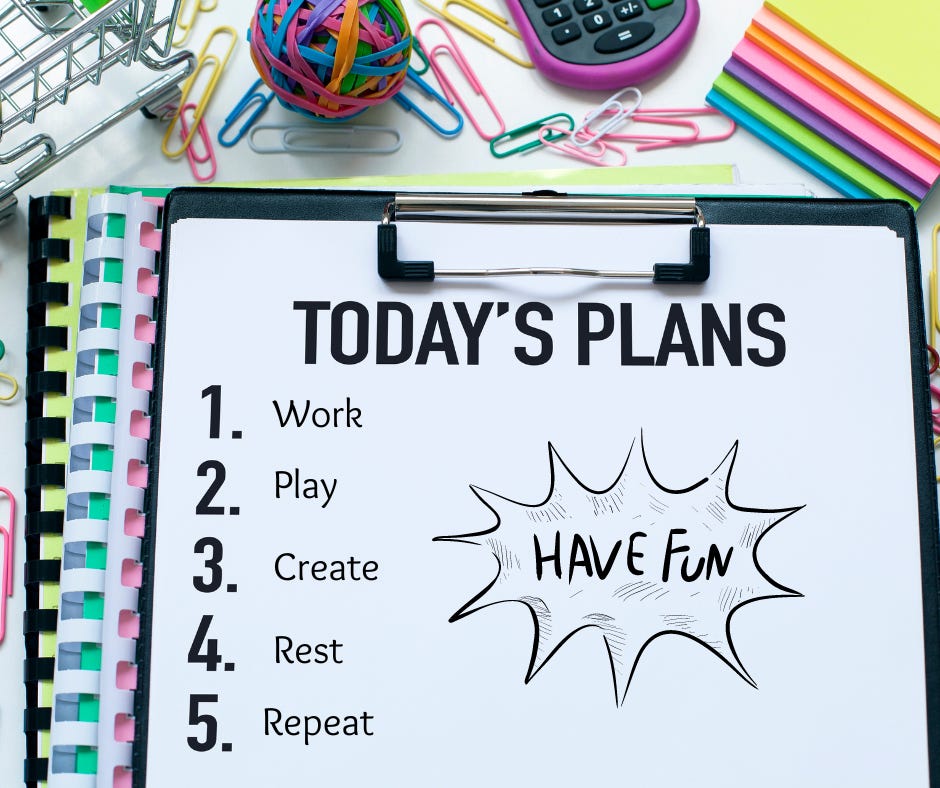
Every morning, I wake up with a plan, which fluctuates to include:
2-3 hours working on paid writing work. I will work longer if the project I am placed on is fun and interesting.
1-2 Hours (as needed) on my editing clients (when they have sent me new material)
I also work on personal platform-building projects, including building my speaking career, writing a new book, conducting research, blogging or writing articles, and doing YouTube and podcast projects.
Holding one-to-one Zoom calls with people for certain projects.
2–3 days a week, I facilitate writing and creativity workshops for small groups.
In between all of that, I take breaks, take naps, play with my dogs, do laundry, take walks, sit outside to enjoy the sunshine, or whatever sparks my interest that day.
I work hard.
I work on a schedule that suits me, take time off when I do not feel like working, and enjoy the work I am doing (except for some projects).
This work allows me to connect with people when my social battery is high. I get to flex my creative muscles in whatever ways I want, whenever I want to. When I am feeling less creative or less in flow, I take on the tasks that I find less interesting and get things done faster.
Sometimes I make a lot of money, but the majority of my work is an investment toward my future. I may never make a lot of money off of these projects, but I don’t care because I am doing work that I love.
By this, I am not supporting the saying
“Choose a job you love, and you will never have to work a day in your life.”
because every job has aspects that you don’t want to do. But, by choosing to prioritize the feeling of flow, flexible time, and listening to my body’s needs, I find more joy in working—regardless of the work.
A Privilege that Should be Available to ALL
I recognize the privilege I have in living life this way at the moment. I have a workaholic husband who loves his full-time job as well as taking on other projects on the side. We’ve both worked hard all our lives and were able to buy our house (with an ongoing mortgage) when housing prices were reasonable. Our daughter got lots of support (unfortunately, including loans) to attend college and works hard to help pay her way. We try to live within our means and have been able to pay down debt so that we have a great credit rating.
Our daily lists take work, but we are doing it. One day at a time.
But, when I hit burn-out in the world of academia, both my husband and I realized that sometimes our mental health is more important than the money we were bringing in. As an adjunct faculty member, I didn’t even have a guaranteed income, so our income fluctuated semester by semester, but my workload was as heavy as—if not heavier than—many of the tenured faculty.
Something had to change for me.
Something has to change in the system we call work.
Breaking Down The Lies They Tell
We’ve heard all the complaints:
“People don’t want to work anymore.”
“We can’t find any qualified candidates.”
“Why should we pay workers more? They need to work harder.”
We know it’s all lies.
Let’s break this down.
“People don’t want to work anymore.”
Bullshit.
My daughter is about to enter her senior year in college. She has a required (unpaid) internship for part of the summer and is stressed that she hasn’t found work to fill until the end of the summer. She’s also started thinking about what she will do after college because she wants to work at something she will love and be able to survive. She is Gen Z.
I am Gen X. After leaving academia, I looked for a traditional job. I was either overqualified (because of an MFA and PhD), underqualified (because the job qualifications were unrealistic), or completely overlooked (because of ageism, I assume). I want to work.
Every day I witness people asking for more work on the virtual platform where I do some contract work. But a combination of heavy reliance on AI, technical glitches, and an overall lack of people management skills means that there are days (sometimes weeks) where there are more workers than tasks.
“We can’t find any qualified candidates.”
I saw this post on LinkedIn this morning.

Job postings are getting more insane every day. They ask for 3-5 years of experience for an entry-level position. They want candidates to come in with all the skills required, plus more. They want fully-trained employees, prepared to start running as soon as they land.
I mentioned above that I was often considered underqualified for jobs. This is because my resume or CV does not necessarily pass the AI check for keywords and titles that meet certain requirements. I am capable of learning any goal set for me after 30-plus years of:
working with and managing thousands of people
bringing projects in on time and under budget
communicating with clarity
organizing and managing time
learning technology as necessary
adapting to challenges
problem-solving
etc.
The list can go on. However, when a company is searching for the perfect candidate and the algorithm doesn’t allow anyone who doesn’t fit the description through the door, then the problem is the system, not the candidates.
“Why should we pay workers more? They need to work harder.”
The paid contract job that doesn’t always have work available recently lowered our base pay and offered a bonus if we recruited more workers. Why would I do that if they can’t pay at the rate we deserve (or higher) or guarantee that there will always be work available? I wouldn’t do that to the people I know.
When I first started with this company, I worked more hours because I enjoyed the projects more, was getting paid the rate I expected, and was making surprise bonuses almost every week. Sometimes the projects were so fun that I found that fulfilling flow that I craved and lost any sense of time. I loved that and ended up working more hours than I planned.
Now I make less per hour on a boring project that doesn’t offer bonuses.
Will I work longer to make up the pay gap? No! I will adjust and spend more time on that long list of work I already do, on projects that inspire me.
The Cultural Change We Need
It’s obvious that late-stage capitalism only works for some people. We need a complete overhaul of society if the world is going to function for everyone.
I’m not an economic expert. I’m not a business guru. I’m not a political scientist.
What I am is a person who recognizes that every individual deserves to have a life that allows for freedom, flexibility, and joy in both work and play.
How can that be achieved?
Here are some simple steps that can at least start the process:
Pay your workers what they are worth, or more, and enough that they can survive on one job.
Don’t demand they work unrealistic hours, which ultimately equates to free labor.
Don’t rely on AI to manage your workforce or your hiring process—pay humans for interactions with humans.
Allow for flex-time, working from home, and unusual work hours.
Provide bonuses for work done well.
Balance tasks between enjoyable work and the more boring ones.
Put people in charge who care about people.
Put people over profit!
Is that asking too much?
I don’t think so.